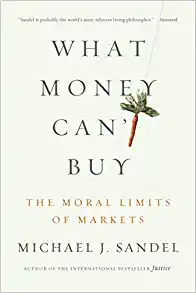
What Money Can't Buy
I was pretty excited for this book based on its blurb! I am a sucker for deeper introspections into the financialization of our society, for better and for worse: I really enjoyed Radical Markets and Economic Fables, two excellent entrants in that genre.
Unfortunately, this book offered little novelty beyond "gee, sometimes market-making is bad." Which is not to say I disagree with the author — I don't think there was a single objectionable claim in the book — but the entire work is a series of repetitive and fairly obvious case studies about how using a market can lead to poor second-order effects.
The reasonable thesis of the book is something out of Seeing Like A State — the act of subjecting a phenomenon (say, financial incentives for children to read) to a market can have unintended consequences, and the cost of (financial) legibility often outweighs the marginal benefits created by the efficiency of the market.
There you go: that's the book. Unlike Seeing Like A State (which features unique reportage in an interesting domain) or Economic Fables (which I think admirably straddles the line between education and memoir), there's just not a lot of interesting meat to this book beyond bludgeoning you over the head with instances of "markets have deleterious effects."
Of course they do! It is not a mainstream economic position to say that market-making is a value-neutral/non-destructive process. There are no insights beyond that, and the book just throws two dozen NPR-tier examples at you and expects you to be satisfied.
"Satisfied" is the word I want to end on; this was an unsatisfying book, and I think a satisfying one requires either stronger prose or deeper research.