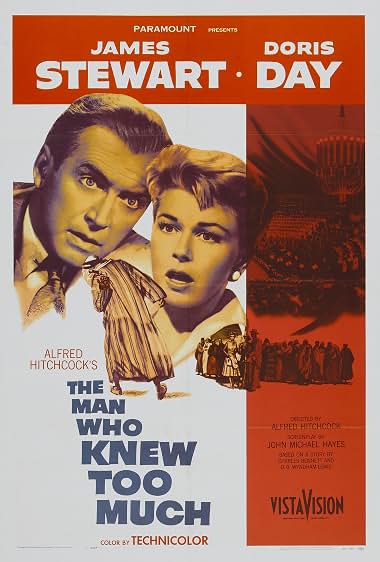
The Man Who Knew Too Much
The Man Who Knew Too Much is a film of peaks and valleys. There is little argument that it is a good film; whether you place it amongst the highest of Hitchcock's work depends on just how much you value the stratospheric heights it reaches, and whether they overcompensate for the lulls.
The film is never weak, but it is weak for Hitchcock in parts. Watching it for the first time, and knowing that it is a Hitchcock film, you feel as though you don't quite need all the foreshadowing and lampshading. As it progresses, you can't help but feel a sense of déjà vu with his other work — remarkable for this film as compared to the parts of his filmography not considered his absolute best.
As a remake of his own 1934 work, and something relatively mid-career for him, it is very much him in his bag, doing what he does and what he is well known for. Compare this with, say, Family Plot, where your mileage largely depends on how willing you are to go along with him doing something much shaggier than usual. Put another way: this is the first Hitchcock film where I found myself not once, but twice, checking how much time was left in the movie and being surprised that there was so much still to go.
But those dizzying heights. There is, crucially, the ability Hitchcock has to wring noteworthy performances from the Jimmy Stewarts of the world — to see something new and interesting in a face you have already seen so many times. I say this without consulting any of my prior notes, but my gut reaction was that this was my favorite Jimmy Stewart performance I have ever seen. He plays a man who fits perfectly the definition of fumbling.
Hitchcock uses his frame for great gags, especially in the first act. But there are two scenes in particular where you see Jimmy Stewart as something an actor of his caliber is almost never shown as: a completely broken man. First, the close-up of him holding the corpse of a dying man, trying to process on many levels the mistakes and errors he has made over the past few days. And then a scene that is grotesque in many ways, but not unrealistic, when he coerces Doris Day — his wife, who must be said is consistently much smarter than him throughout the film — to take a fistful of tranquilizers before he delivers the news that their son has been kidnapped.
For all the love I have for Cary Grant, he tends to have a certain problem in Hitchcock films of being too starkly charming in the scenes where terrible things have happened to him. Jimmy Stewart crumbles, and stays crumbled, until the very end.
And then, of course, there is the VistaVision and the scene work. I am not smart or well versed enough to talk about the technology and how Hitchcock used it, but the aesthetics are perfect and gorgeous. He relies a lot on static shots, especially when we are first introduced to Marrakesh, that — like a discordant note held for slightly too long — usefully upset the viewer.
But where I must end this review is, I imagine, with the set piece that most people think about when they think about this film: Albert Hall. Five minutes of opera and those aforementioned static shots, not a single line of dialogue, but stress building and building and building — for me, it is indelible, and so powerful that even after I forget the silly international spy bits, I know I will remember it for years to come.
I think this is correctly placed in the mid-tier of Hitchcock's canon. His best films are tauter and have more things to say, tauter and carry more opinions than this one does. But a middle-tier Hitchcock film is still a very good film. And if I got to watch something this good every evening for years to come, I would consider myself a very lucky filmgoer. 8 out of 10.
One last thing: Doris Day was great. The script did not really give her much to display any sort of range, despite the character herself being very competent and capable and, again, much smarter than Jimmy Stewart's — but there's just not a lot for her to do. Honestly, the same could be said of Jimmy Stewart's character, and to a certain extent that's why parts of the film drag as much as they do: you get the sense that our protagonists are, up until that Albert Hall scene, passive observers more than they are agents of the action. Not a sin in and of itself, but it exacerbates the drag in the middle of the film, because everyone is just going through the motions. But Day's performance in that tranquilizer scene is unimpeachable — and, as with Jimmy Stewart, not something you're used to seeing from an actress of her stature.