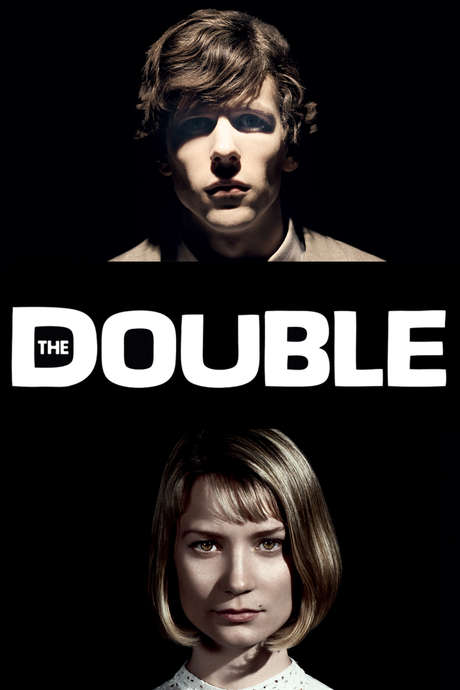
The Double
A person can get really sick by just floating by.
More than anything, I'm surprised this film doesn't have a bigger following. The constellation of its characteristics—directed by Richard Ayoade, a nerdy adaptation of a Dostoevsky novella, Jesse Eisenberg playing two roles against himself—all of these things feel like they should have left a larger imprint on the collective consciousness. And yet here we are, a decade later, and I had to actively seek it out, and I'm glad I did.
The film is genuinely very good. There's an aggressive flashiness to much of its production that somehow never tips into excess. The sets are minimalist and retrograde in a way that lampshades the aesthetic without ever grating on you. It reminds me, in particular, of Joel Coen's The Tragedy of Macbeth—visually striking at the surface level in a way that gives panache to an adaptation without devolving into the rococo.
Every individual piece works: Eisenberg playing two versions of himself is a gimmick, sure, but it's also literally the point of the source material. And he pulls off the tall task with more than mere capability: the film only works because you can deeply believe these two people occupy the liminal space between one and two, with differences not just in posture or personality but in something a little more ineffable.
Some things work less well: the supporting cast—which is to say, everyone who isn't Eisenberg—seems a little too hungry for scenery at times. The overacting occasionally conflicts with the intentional dourness of the script and setting. It's hard to convey banality and menace simultaneously, and not everyone threads that needle. But the music and visuals are wonderful and terrible in equal measure, and the film introduces enough intrigue and wonder without relying entirely on ambiguity as a crutch.
I opened this review mentioning my surprise at the lack of conversation around this film, and I think part of the answer lies in its opacity. Like the original novella, The Double leaves things up to imagination—how the doppelgänger mechanism actually works, for instance, and whether we're meant to read this as psychological fracture or something more literal. These ambiguities can frustrate viewers looking for resolution.
Ayoade is careful not to insinuate Simon's meekness is virtue. Our protagonist is still a guy who digs art out of dumpsters and spies on his neighbors through a telescope. James's sins are perhaps worse, but at least (in Simon's mind, and perhaps at times our own) he gets what he wants. Simon's early rant to James is the closest we get to making the subtext text:
I don't know how to be myself. It's like I'm permanently outside myself. Like, like you could push your hands straight through me if you wanted to. And I can see the type of man I want to be versus the type of man I actually am and I know that I'm doing it but I'm incapable of what needs to be done. I'm like Pinocchio, a wooden boy. Not a real boy. And it kills me.
In the film's final moments, Simon declares that he "doesn't want to be a boy held up by string." He severs the string by killing the version of him that has everything he wanted, and in so doing supplants that version.
But he does so by jumping off a roof in the same manner as another shadow of himself did in the film's opening moments. Did he survive the fall, or did he miss the net? What I am saying — what I think Ayoade is saying — is that you'll never know until you feel the ground.