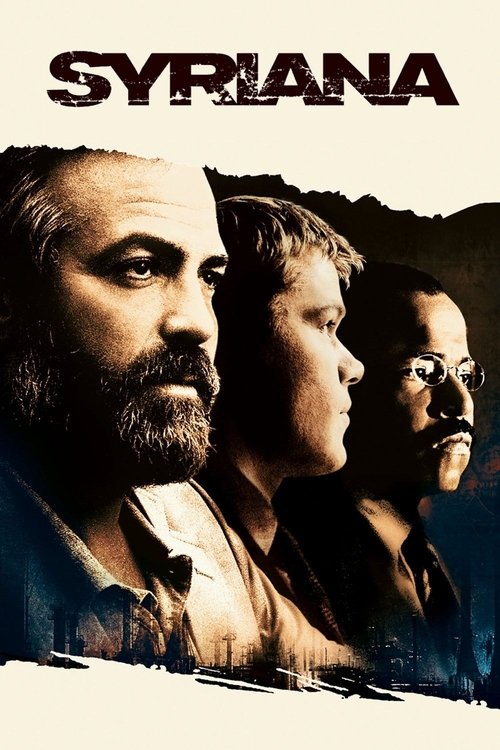
Syriana
It’s easy to dismiss Syriana for a variety of reasons. It follows two films that are, on the whole, better and more interesting—Traffic and Michael Clayton. It’s somehow both dense and overstuffed, thick with plotlines that disorient more than they illuminate. And yet there’s a lot of good material here.
Depending on your appetite for Iraq-era cynicism, you may find yourself aligned with Matt Christman’s praise for the film; I largely do. Like Traffic before it, Syriana tries earnestly not to use its setting as a backdrop for a McGuffin. Gaghan wants to explain how this world works, and what exactly is so rotten within it. Despite that ambition, it’s hard to accuse the film of having much nuance.
Perhaps that’s intentional. I don’t think we’re meant to see shades of gray among the characters so much as shades of gray within the extremely limited set of actions they can take to make anything look better. But the characters themselves—let’s talk about the performances.
This is the role for which Clooney won his Oscar, which still feels baffling. His performance is good insofar as it is, for the first time I can remember, consciously and deliberately not “George Clooney.” There’s a stoicism and editorial remove that fits both the character and Clooney’s self-image, but it’s not a revelation onscreen. I’ve seen many portrayals of jaded, embittered operatives, and while I love Clooney, his doesn’t exactly rank among the best. The same can be said about Damon.
Maybe this is my new-dad sensibility talking, but the entire plotline of his son’s death feels like a reverse-engineered excuse to draw an American into the inner fold. It attempts to milk some drama, which would be fine, except Damon plays the whole thing so flatly that you wonder if the scenes were shot out of order. Peet’s anguish is one-note, but at least she sells it.
Damon’s emotional register consists of “sad during a CNBC interview” and “angry in the desert,” and then he’s off. All of this makes me think I’d have enjoyed the film more if it had leaned further into documentary mode—ditching the melodrama, ditching the more contrived plot threads. And yes, I realize I often complain about Netflix stretching everything into mini-series length instead of a tight two-hour film.
But Syriana feels like the rare case where the reverse might have worked. One could imagine a six-episode series, each one taking a different point of view from the film and letting it breathe.
The last thing I’ll note is contemporaneity. One of the challenges of revisiting Traffic today is that it, like Syriana, emerged in a moment when challenging the prevailing narrative—when rejecting simple good-guys-versus-bad-guys framings—felt brave and valuable. And at the time, it was. But we now live in a world where the average person understands far more about these geopolitical complexities than audiences did then.
With that context gone, you spend more time noticing where the film can’t quite add grace notes or color: the squadron of identical oil men with vaguely similar names and vaguely awful Texas accents; the empathetic but ultimately flat portrayal of two laid-off workers sliding toward suicide bombing.
It’s a film with real value. But I can’t help feeling I’d rather read a book about these dynamics—and also get to rewatch Ocean’s Eleven.