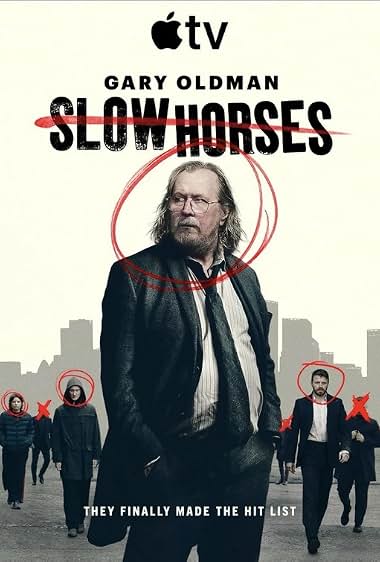
Slow Horses (Season 6)
Slow Horses changed showrunners this season. And while I think this was capable television that accomplished exactly what it set out to do, I'm finding that the past three and a half seasons of the show — which is to say, starting with the climactic sequence of Slow Horses (Season 3) in all of its bang-bang shoot-'em-up glory — have drifted increasingly orthogonal to what I loved so much about the first season.
I would argue that the show has two main themes:
- Institutions prioritize their own survival above anything else, and accordingly reward the individuals who are good at prioritizing their own survival.
- People don't change. Events calcify them rather than transform them.
Every season of Slow Horses delivers arguments in favor of these two theses. Sometimes the arguments are small, like Shirley's aside about what to do with scary feelings: bottle them up, push them down, and keep pushing them down, and never stop pushing them down. Sometimes they're large, like the show's overall arc in which Taverner triumphs over the course of this season.
That being said! What I find increasingly difficult to ignore is the sensation that the plot of Slow Horses is less a connect-the-dots and more a coloring book: the showrunners (and, of course, Herron) start by figuring out the end state of each season and a handful of great set pieces they want to stage — some of which are hilarious, some of which are steeped in emotional pathos — and then lazily color in the plot to make sure we get there.
This used to be reserved for a single (albeit overwhelming) sequence per season. This season, we have, off the top of my head:
- A pair of Russian agents who appear to have either supernatural powers or a homing beacon planted on every single one of their targets.
- A Call of Duty-esque chase sequence in which two protagonists manage to steal a truck full of oil and roll a barrel just so, such that it explodes an SUV full of Dogs chasing them down.
- After doing so, one of those protagonists is let off from custody completely scot-free by other MI5 agents on the strength of a couple crude remarks.
- A new media mogul character who exists purely to provide the motivating and concluding actions for the season, as neatly and as caricatured as possible.
- The concept of being "scrubbed from the database" exists.
You get the idea.
The spycraft on this show increasingly resembles Archer more than it does Le Carré, which is unfortunate: the gravity of the spycraft and the plausibility of the events are what underscore everything else the show seems to be interested in. (Or, at least, what I want the show to be interested in.)
And yet. There are beautiful moments in this very funny and compelling season of television: the scene at the lake; the extended action sequence at the service station-cum-arcade; and most of all, the wordless final minutes of the finale. Those scenes — plus a writers' room that, six seasons in, still knows exactly how to land an incredible one-liner — are why I'm still excited for a seventh season that I know I'll watch on day one.
I just wish I was really excited, rather than merely resigned to being excited.