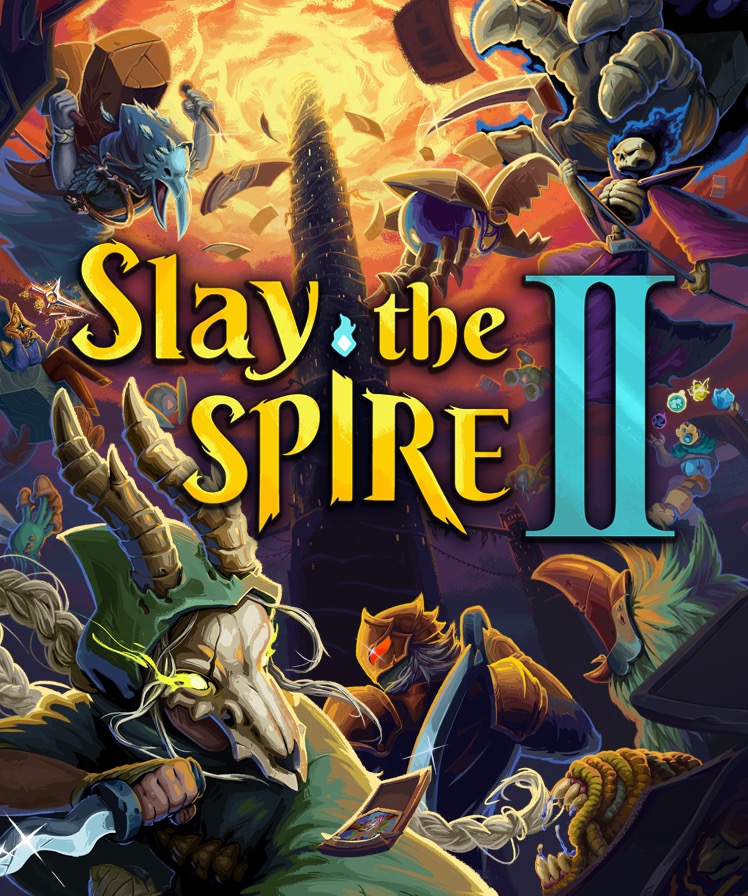
Slay the Spire 2
I have played Slay the Spire 2 for around thirty hours. I am, after writing this review, uninstalling it from my laptop and praying my resolve is strong enough to keep it that way: a testament, to put it mildly, to how perfectly calibrated this game is and how effortlessly it enables my least productive tendencies.
This is as good an opportunity as any to talk more about Slay the Spire itself, because — as I inelegantly put it to my brother — the sequel is a lazy one. By which I don't mean any moral judgment, but simply that it is a pure continuation of its predecessor: same engine, same mechanics, same gameplay loop, a host of new cards, new characters, new events, new enemies.
To say that Slay the Spire 2 is derivative is both true and laudatory. I played the original game for at least five hundred hours and could easily pour the same amount into this one. I find Slay the Spire to be such a beautiful and addicting game because it seems expressly designed to strip away everything from an RPG that is repetitive or meaningless. Every decision you make is meaningful. Randomization between runs keeps everything fresh. Emergent interactions between the game's various mechanics provide a sense of progression and mastery, at both the implicit and explicit levels. Each run takes forty-five to sixty minutes, which is not just perfect for a single sitting but just long enough to justify booting up a new one. Every single time I've told myself I would stop in the middle of a Slay the Spire run, I have failed against the gravitational pull of one more turn, one more event, one more act.
Many games have followed in its wake, but few come even close to the original formula, which is so beautifully forged, design iteration by design iteration, to be both simple and fractally complex.
The sequel adds a couple of new characters and mechanics, and these are interesting — they play around with converting the core resources of the game. The Regent has not one but two sources of energy. The Necrobinder's block, rather than being transient and disappearing at the end of each round, is persistent, manifesting as an undead hand you have summoned. Scaling in general comes less from powers (static, boring) and more from emergent factors like exhaust. Some mechanics are underbaked, like Quests — that's okay, this is technically Early Access.
If I were being more intellectually honest, I'd evaluate Slay the Spire 2 the same way I might evaluate Ocean's Twelve: a derivative but pleasurable piece of art who owes much of its success to its predecessor.
But the difference between the two is this: I know I have revisited and will revisit Ocean's Eleven — the superior film — many, many times over. I'll probably not rewatch Ocean's Twelve ever again, even though I enjoyed it. And I don't see myself playing Slay the Spire (that is, the original) again, even separate from its opioid-esque tendencies. Part of this is, perhaps, exhaustion — the extent to which I feel I've completely finished the original; but mostly the reason is because Slay the Spire 2 feels like a major version of a sort. Even the characters who have carried through from the first into the second are more nuanced and interesting to play this go-round/ They improved the formula and in doing so obsoleted the old one, which is a very hard thing to do.