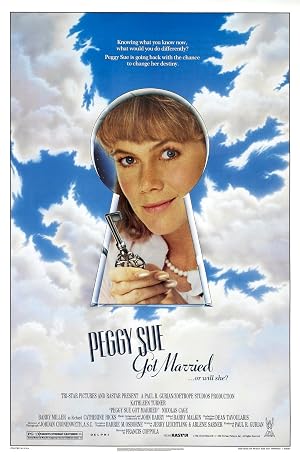
Peggy Sue Got Married
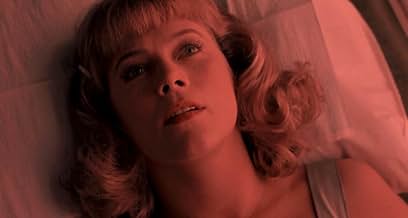
I envy you. You have your whole life ahead of you and you know exactly what you want to do. But forget the rat puke; write something beautiful.
You don't know zip! You think I'm going to end up selling appliances like my father? Chasing women around the store. I've got to give it a shot. Why are you trying to kill the two things that mean the most to me? Until yesterday you loved me and you loved us.
I watched this absolutely bizarre film solely on the back of being fascinated that Coppola had to do so much commercial work to support all of his less-than-successful creative work. It is an 80s film about going back to the future — which is to say, it came out one year after that film, and apparently this recontextualizes much of it. But as someone who really doesn't care that much about Back to the Future, I can take it on its own merits.
Its own merits are just: deeply strange?
You have Kathleen Turner being entertaining but entirely overacting the entire film, traveling back to her high school years with Nicolas Cage (whose best friend — by the way — is Jim Carrey) cosplaying as a 50s lounge lizard with the worst nasally accent you have ever heard. It has apparently taken me this long to discover that Cage was Coppola's nephew, a fact made even funnier by his having also cast Sofia in a minor speaking role.
You almost certainly know exactly how this movie is going to turn out by the 15th minute or so, and the question then becomes whether the scenery along the way makes it worth your while. Bizarre choices abound in every line reading and abrupt scene transition: almost gratuitous sacrifices to requisite 80s comedy — the snarky high schooler who gets her comeuppance, and so on, punctuated by moments of melancholy and tenderness that make you forget just what it is you're watching. You have a faux beatnik deploying Yeats in a way that works both textually (it's a very lovely, sonorous poem) and metatextually (the authors understand that the pilgrim soul is Yeats' way of being a dick).
Cage's character is in many ways the protagonist of the film, and Turner the viewpoint character; she remains static while our understanding of him changes radically. Charlie is vain, ridiculous, overbearing, hyperreactive; he also seems to genuinely love the protagonist. His dreams get dashed not due to cosmic justic nor awful luck but due to the ways of the world; he errs, and he attempts to atone for his errors. The clever trick of the film is that Turner does not end up leaving the past with a better understanding of herself so much as she leaves with a better understanding of her soon-to-be ex-husband: that he is a man who wanted big things that did not quite materialize; that he is a buffoon who will do anything for her.
For the first two-thirds, the film is dominated by the schizophrenia of jumping between the two movies it's trying to be: the reflective, somber, Proustian meditation and the formulaic nostalgia-driven cash-in. This incoherence finally reconciles in the movie's sweetest scene (in a movie already filled with them), in which Turner visits her grandparents, a scene which fulfills two purposes:
- Her grandmother is psychic and her grandfather belongs to a Masonic lodge that is actually a time cult
- Her character is the person who more than anything else that could be granted by a trip to the past — fortune, fame, power — chooses an evening with her grandparents
The film is both fatalistic and deeply, deeply humane; it is a lucid dream, in which you know (however hazily and briefly) that you will wake up in your own bed, but are willing to get taken along for the ride in hopes of remembering something interesting.