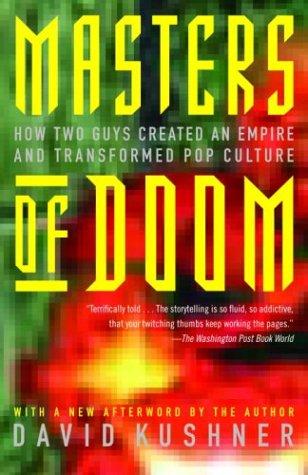
Masters of Doom
One way to approach writing about Masters of Doom is to talk about its outsized influence. Just off the top of my head: two pretty meaningful pieces of art about technology — BlackBerry and Halt and Catch Fire — both crib heavily from its narrative and its depictions of the early-90s technology zeitgeist. On the private-sector side, the founders of Reddit and Oculus both cite it as a core text that inspired them to start their companies.
While in 2026 some of its narratives and ideas sound a little dated or pat, it manages to be both hagiographic and educational. Kushner does a good job balancing the personality cult (though I found the cloying early chapters about the various protagonists' childhoods to be unrewarding) and the legitimate technology breakthroughs that brought id its success and fame.
This is perhaps the strongest thesis espoused by the book, which goes something like as follows: id Software was successful because it had a maniacal engineer single-mindedly focused on technological breakthroughs, and creative designers in his orbit who could leverage those breakthroughs into games beloved by millions. Everything else is incidental and auxiliary, and the alchemy of Doom and Quake's success hinged on the chimeric bond between the two Johns, neither of whom were able to replicate it independently.
In the twenty years that followed, of course, the narrative becomes a bit messier. We leave the book before Doom 3 was released, and while Kushner suggests that Doom 3 may be a middling title and that Carmack is no longer interested in engineering, he manages to both hit and miss the mark. Doom 3 was another smashing success, but id Software faded into irrelevance shortly thereafter, and the realm of first-person shooters became dominated by the antithesis of id Software: very large tech companies with embedded game studios, treating the production line like a factory floor rather than a monastery.
Romero's career after Ion Storm is hallmarked by a series of downwardly mobile steps — a fate that, if I may borrow some of Kushner's psychoanalytic inquiry, must seem a little worse than death. Having achieved fame and fortune, but not peace, and having burned through two more wives and four more studios since the book's publication.
For all the duality that Kushner tries to imbue into the narrative, this is really Carmack's story, and Carmack's arc after the book is less depressing, but more surprising. Despite vowing to never sell, id Software sold to ZeniMax in 2009, having achieved nothing notable since Doom 3's launch six years prior. Four years after that sale — and with nothing more to show for it besides perhaps a larger checking account — Carmack left to go work on Oculus as CTO, which is both a confirmation of the book's espousal of Carmack's love of VR and yet objectively a bit of a failure. Oculus never achieved anything close to mainstream success, and ten years after he joined as CTO, Carmack left Meta to work in his own personal AGI lab.
Carmack is an interesting character, and I think some of the stickiness that Kushner deploys when describing him — the autistic mannerisms, the obsession with pizza and Diet Coke — belies what is truly great. Carmack is relentlessly charitable with intellectual property. He is also, as the book describes him, a sociopath who is willing to give away his cat if it starts bothering him, and cut his friends out of a company in order to meet his ends. We know through many media of technical sociopaths, and generally associate them with greed and vanity. Carmack is not one of those people. He seems earnest and driven, and also, during the book's events, a 20-year-old who is in way over his head.
I started off this book really not liking it, and then by the end — the power of the narrative, the slow progression into the world I remembered of my youth, having never played Quake but knowing most of the personalities and zeitgeists depicted, including a US populace that was obsessed with the concept of video game violence (a concept which now seems alien) — my esteem of it kept ticking up and up, until it became a book I would generally recommend, and have done so already.
Kushner's reportage is impressive. He moved to Texas for five years to embed himself in the history and the scene, and this is not the airport book it feels like at first glance. It is not Barbarians at the Gate, but it is something quite close.