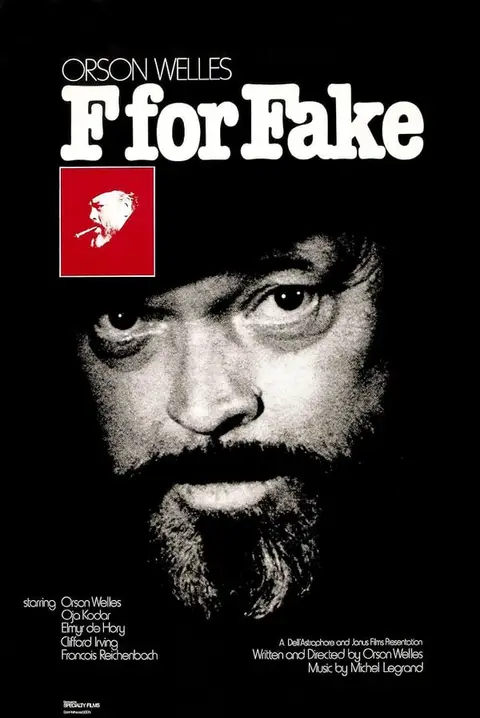
F for Fake
Our works in stone, in paint, in print, are spared, some of them, for a few decades or a millennium or two, but everything must finally fall in war, or wear away into the ultimate and universal ash — the triumphs, the frauds, the treasures and the fakes. A fact of life: we're going to die. "Be of good heart," cry the dead artists out of the living past. "Our songs will all be silenced, but what of it? Go on singing." Maybe a man's name doesn't matter all that much.
Reality? It's the toothbrush, waiting at home for you in its glass. A bus ticket. A paycheck.
Here is a movie that was derided as self-indulgent and aimless at the time of its release, and is now lauded as groundbreaking and eternal. Both seem more or less correct. More than anything, I come away from the film wishing that a slightly better version of it existed. That being said, as it stands, it's a pretty good way to spend 90 minutes. But I think a different version of it could be absolutely extraordinary.
Welles circles around one single question: the value of art. And I think perhaps due to what was then a very novel style — one that we'd now perhaps associate more with autofiction and writing than with filmmaking — there are a couple of casual flourishes that deplete the enterprise. His abrupt, aborted transitions. And the too-clever "twist" at the end.
But he ends with two points that, whatever other faults, are sympathetically rendered. One, that in the grand scheme of things, art dealers, specifically knowing ones, make more money off of forgeries than the forgers themselves. And two, that authenticity, such as it is, is something we talk about when worrying about the status of a great master, but not, say, the cathedral at Chartres.
Are either of these points things that could be presented in some other form of film? I would say no. I think it is very deliberate.
Lastly, it must be said: Orson Welles has a magnetism to him. Shaggy as it is, this film survives on the connective tissue borne to it by his narration. And there is no one else, not even better documentarians, who could have made this better than he could. Perhaps that is a useful watermark to judge directors by: less by the out-and-out quality of their work and more by its singularity.