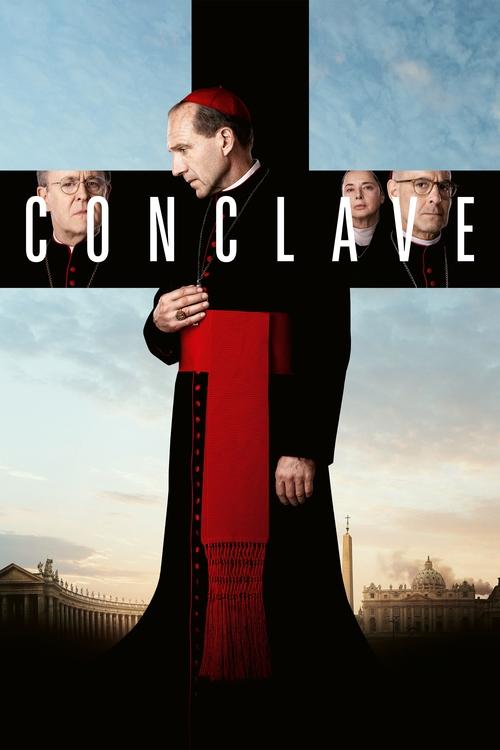
Conclave
I briefly and incorrectly thought that Conclave was a serious film in the style of, say, The Young Pope. This is not the case. The plot is deeply unserious, based off of a novel from Richard Eggers, whose work I encountered briefly earlier this year in the context of The Ghost.
Once you strip aside all of the papal machinery, we are left with a cliché blow by blow in the style of Twelve Angry Men or an Agatha Christie whodunit, where we begin the film with five potential new popes and get whittled down one by one through various revelations until we're left with one, at which point the movie ends. These revelations are reminiscent of an airport novel, which makes sense given the script's progeny, and much of your love of the film will be mediated by how well you can handle the increasingly absurd twists to justify each potentate's disqualification.
Because if you can set aside the silliness of the plot, everything else is sumptuous. Ralph Fiennes is, as always, perfect. He is an actor who reveals so much in shadows or twitches of his face, and he is left in a very reactive role here, getting to play off of an ensemble cast of expert scene chewers. It is shot gorgeously in an obvious but lovely painterly style with a bombastic and over-the-top score to match the bombastic and over-the-top plot. It is a feast for the senses.
What do you think this film is trying to tell us? A cynical answer might be this: Hollywood loves films that glorify institutions. And there's no better path to glory than a hint of cynicism right before the beatification. We are meant to end the film impressed with the papacy, impressed with their ability to choose out of so many candidates a truly holy man, and then not to have ended a truly holy man. There's not a lot of meat on this. And perhaps that is what we want this film to be—a thriller that embraces convention. But I've seen a lot of thrillers, and to judge this movie by the standards of that corpus, I think it is found wanting.
Where I am impressed, though, is the moments of quiet and subtlety. Ralph Fiennes' character professes throughout the film that he has a crisis of faith, that he wished to leave the church and was persuaded otherwise, and that he hopes to help lead the conclave but not emerge from it a new pope. And yet, despite those repeated intrigues, we learn deep down that he in fact does have higher ambitions, that he has in fact chosen a name for himself. And when the time is right, when he is beseeched by his friends to make a play for the chalice before him, he is knocked off his feet by an act of God, and from the rubble becomes a changed and wiser man.
This too is not a particularly subtle bit of cinema, and the scenes that follow it feel almost farcical. One of the things that I found most bold and interesting about The Young Pope was its refusal to marry youth and progressivism. Whereas here, the conservative wing of the papacy are so cartoonish and one-note, you are deprived of any meaningful engagement with their thought, but all of the little threads leading up to it and the brief glimpse we get into Ralph Fiennes' inner life and inner turmoil make it all worth it and rescue the film, at least in my eyes, from merely being a visual feast of empty calories.