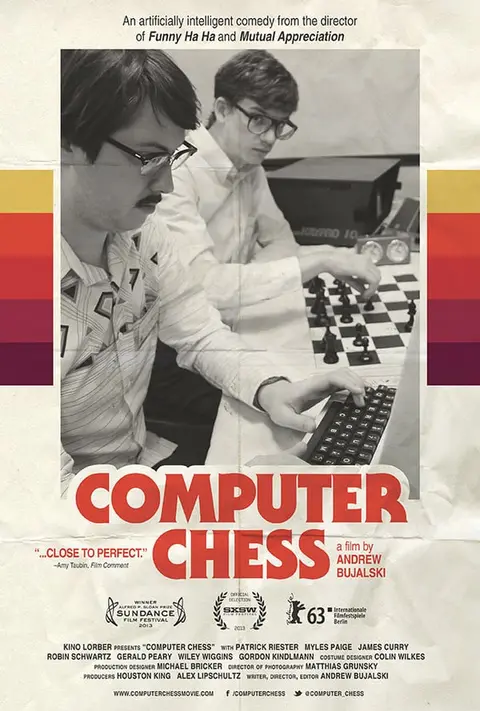
Computer Chess
Computer chess is about as perfect a metaphor as one might hope for, because every little move is so rich. You have chess itself, a simulation of human conflict. You've got the concept of trying to have machines beat humans. But in order to do so, you must have machines think more like humans — or at least learn from them. That's also a topic explored strikingly within Go by Labatut in The MANIAC.
This film by Bujalski seems more interested in following all of those individual ideas down blind alleys, while also committing to a very fun retro-core filming apparatus that sometimes descends into cubism, showing off just to show off. But we can forgive him for this. Even if this film is slight — and more interested in, to use the terms of computer chess, breadth-first search — it still contains moments of deep glory. To me, one of the most striking things I've seen on film this year is the conversation between a young Peter and a chess machine, which stops answering questions and starts asking them.
There is so much ripe symbolism here, too. Overanalyze, for instance, the umbilical cord. First exposed by the human potential movement halfway through the film, it gets cut from older couples attempting to shed their programming. And then in the closing moments of the film, the wires of the computers are framed as umbilical, of course. Then there's the final, blink-and-you'll-miss-it shot of the prostitute revealing herself to be some sort of cyborg.
All of this feels a little bit like sleight of hand. I found myself thinking: what does Bujalski wish to communicate with this movie? He seems very interested in the questions and non-committal about the answer. I, for one, take the answer to be simple. For all the jokes and novelties and idiosyncrasies that the film presents, largely in service of comedy for the humans, the same ones exist for computers. Humans, both individually and as a species, do not evolve and fix themselves through deliberate process or machine learning. The same can be said for machines: the two most powerful chess engines we see in the film are one that holds its own despite being written by a hobbyist with no processing power or hardware available, and the other through the accident of consciousness.
Here is where the movie takes on a strangely contemporary resonance, because I watched this not in 2013, but 2026 — and the term artificial intelligence surrounds us, not as science fiction, but as a buzzword. And the answer appears to be that both things are true to a certain extent. LLMs were practically created as an afterthought in a little-regarded scientific paper, but then we discovered that if you throw more and more and more processing power at a fundamentally simple architecture, you can grow not linearly, but exponentially further.
But I digress. This was an independent movie shot with ambition, curiosity, and wit. I am ironically grateful to Opus 5.5 for recommending it.