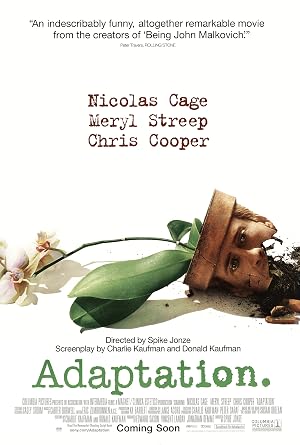
Adaptation
Eighteen months ago, I wrote in review of Being John Malkovich:
The worst thing a piece of comedy can do is, in the process of not taking itself seriously, forget to take its characters seriously. This film is deeply funny, and deeply weird, but Kaufman remembers every step of the way that these people are real, that they want things and feel things. (And I'm sure there are a lot of interesting things it's saying at a metatextual level, but I figure I should finish watching Adaptation before I mull on those too heavily.)
And now, having finally watched Adaptation, I feel as though I can adequately comment.
This is the first Kaufman film that has left me with a lesser level of respect for him than before. It has moments of greatness, many of them not owing themselves to the script. Streep's performance, both comedically and somberly, is brilliant — a couple of shots of her transfixed in thought, in particular the scene where she watches Laroche make a sundial (or the moment a few minutes later, when Charlie runs into her in the elevator and does nothing), are singularly devastating in a relatable way. For who amongst us has not had a tiny little non-incident in passing force us to zoom out and realize that we are standing in a swamp?
Some of the production gimmicks, especially in the film's first act, are fun too. And while it's not exactly high cinema, I think Nic Cage acted well enough to earn the gimmick of being billed twice.
But outside of the performances and a couple of particularly good shots, the film is juvenile, both in a straightforward way (lots of objectification, lots of the word "fatty") and an existential way.
Take a film that more people have strong takes about: Everything Everywhere All At Once. Detractors of the film will argue that it sacrifices substance for style; nobody would argue that it's not trying to deploy its style for the purpose of its emotional arc, just that it is unsuccessful in doing so.
Adaptation, conversely, is clearly about passion and the creative process — but its underlying structure undermines its ability to concretely say anything about these topics beyond the fact that Charlie Kaufman spent some time thinking about them. (Perhaps we can credit Kaufman with the invention of irony poisoning!)
Bringing up EEAAO also reminds me that much of my 2026 viewing of this film is tempered by how far we've come creatively in the two decades hence. Lampshading (a la Brian Cox's screenwriting teacher) is now old hat; recursion is seen in all media, because we have a stronger understanding of how all media is recursive. But this is not the Velvet Underground: Adaptation might be early to some of these things relative to mainstream cinema, but it ultimately relies on novelty and audaciousness (and a hope that you'll find it sufficiently clever) to be worth seriously recommending.
Let me end on a positive note, which is Streep's final line reading and the best I've heard all year:
It's over. Everything's over. I did everything wrong. I want my life back. I want it back before everything got fucked up. I want to be a baby again. I want to be new. I WANT TO BE NEW.