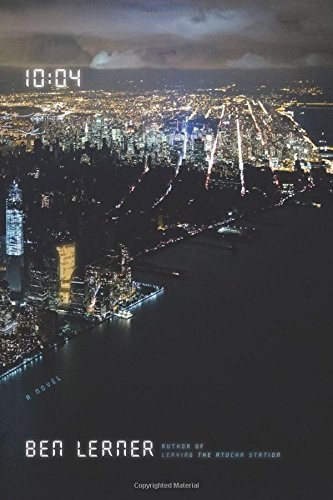
10:04
Art has to offer something other than stylized despair.
Something I hadn't really considered before reading 10:04: my experience with autofiction has been almost entirely dominated by women writers (Cusk, Offill, Lockwood, Nelson). There is probably something interesting to examine here — a continuation of A Room of One's Own, Woolf extended onto the present, a sort of rebellion by the feminine to allow (and demand) their inclusion in what is allowed to be fictionalized, which is to say what is allowed to be fiction.
There's also probably something to be said about the inherent power dynamics of autofiction, and 10:04 spends time discussing this at length in a way characteristic of the rest of the book: circuitously, coyly, and in a manner I would otherwise find annoying if the author were not such a strong stylist and clever thinker:
that part of what I loved about poetry was how the distinction between fiction and nonfiction didn't obtain, how the correspondence between text and world was less important than the intensities of the poem itself, what possibilities of feeling were opened up in the present tense of reading
She said she hoped she would see me again, and the next thing I knew I was running through light snow back to my dorm, laughing aloud from an excess of joy like the schoolboy that I was. I had overwhelming sense of the world's possibility and plentitude; the massive, luminous spheres burned above me without irony; the streetlights were haloed and I could make out the bright, crustal highlands of the moon, the far-sprinkled systems; I was going to read everything and invent a new prosody and successfully court the radiant progeny of the vanguard doyens if it killed me; my mind and body were as a fading coal awakened to transitory brightness by her breath when she'd brushed her lips against me; the earth was beautiful beyond all change.
Nothing in the world, I thought to myself, is as old as what was futuristic in the past.
And this is ultimately where my analysis of 10:04 starts and ends. Ben Lerner is, at least in this estimation, a smart and clever prose stylist whose powers of observation and reflection are interesting but not meaningful.
I enjoyed this book, and I could get ensorcelled — however briefly — in the trappings of its recursions. But whatever heights it reaches, the book is trapped by the fences of its context. I don't mean this as a slight against anyone but myself; I simply don't think I have that much to learn about the world from learning about Ben Lerner.
And despite all the lampshading, this is a book by Ben Lerner about Ben Lerner. Reading it has made me more interested in seeing his other work — and less interested in ever recommending this one to someone else.